


Most B2B companies already have some good videos. They may have a product video, an explainer, or a customer success story. Each one was created for a specific reason, such as a product launch, a marketing campaign, a trade show, or a company rebrand.
The videos themselves are often good. The problem is that they usually exist as separate pieces, without a clear role in the buyer’s journey.
B2B buyers don’t make a decision after watching one video. They move through a buying process that can take weeks or months and often involves several people. At each stage, they have different questions and need different information.
A single video cannot answer every question for every person involved in the decision. That’s not because the video isn’t good enough. It’s because every video has a specific job.
Instead of thinking about video as individual projects, it helps to think about it as part of a communication system. The important question isn’t simply “What video should we make next?” It’s “Where in our buyer’s journey can video help us most?”
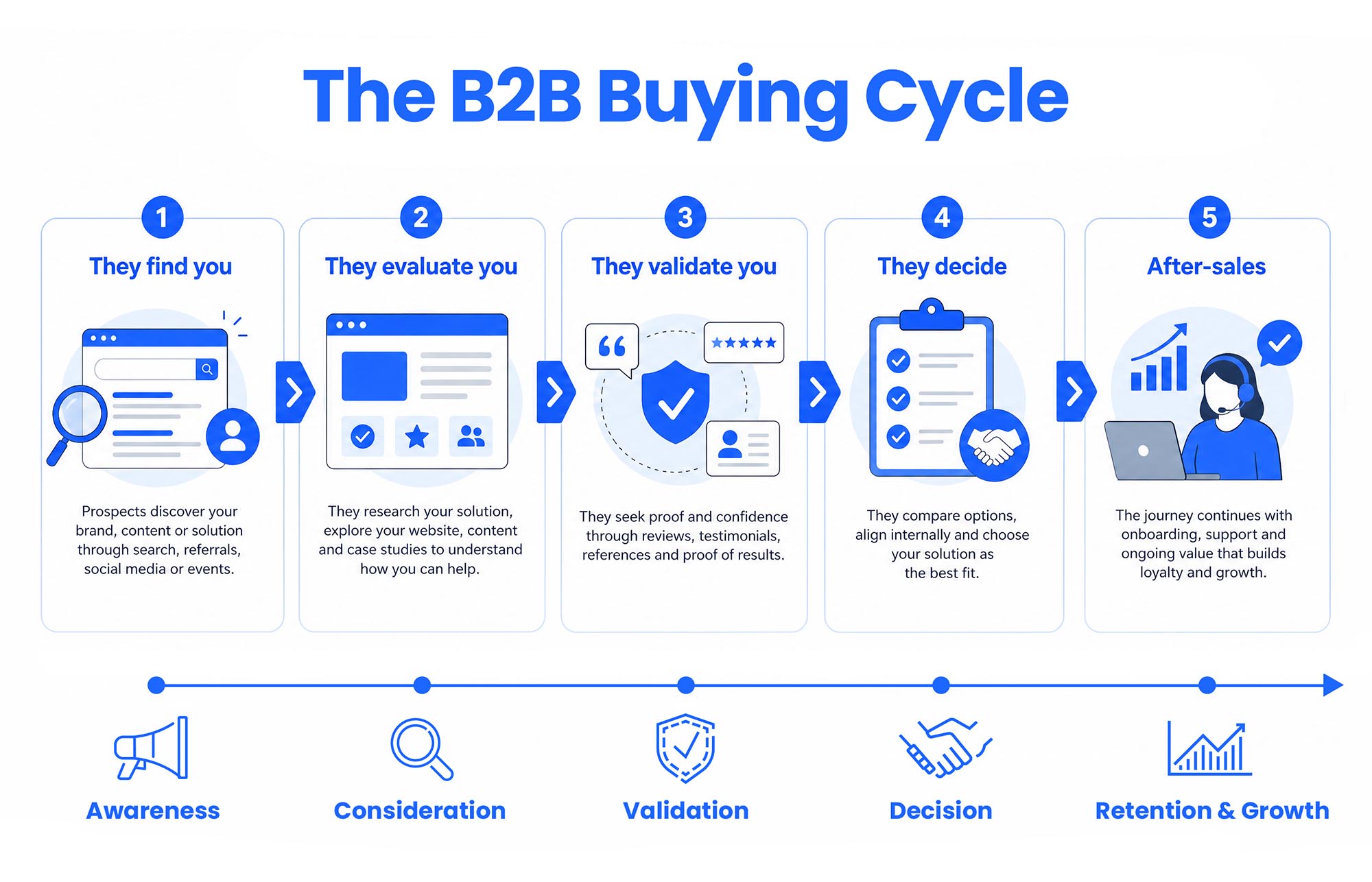
The B2B buying cycle
Every B2B purchase is different, but most buying journeys follow a similar pattern. They usually include five stages.
1. They find you
Someone discovers your company. It could be through Google, LinkedIn, a recommendation, an event, a trade show, or your own outreach.
At this point they are simply trying to understand who you are and whether you’re worth looking into.
2. They evaluate you
This is where buyers start doing their own research.
They visit your website, read your content, watch your videos, compare you with competitors, and build an opinion before speaking to your sales team—or sometimes without speaking to anyone at all.
3. They validate you
Now the conversation becomes more detailed.
More people often join the decision, including technical specialists, managers, or executives. Instead of asking “What do you do?”, they’re asking “Will this work for our specific situation?”
4. They decide
Commercial discussions become more important.
Buyers compare prices, review contracts, assess risk, and decide who they trust.
Although this is where sales teams spend most of their time, much of the decision has already been shaped by everything that happened earlier.
5. After-sales
The relationship doesn’t end when the contract is signed.
Customers need to adopt your product, get value from it, and continue using it successfully. This influences renewals, upselling opportunities, recommendations, and future growth.
For companies that sell through distributors or partners, this stage also includes helping others represent and sell the product correctly.
Video has a different job at each stage
One important thing to notice is that you are not always part of the buying process.
During the evaluation stage, buyers are often researching without talking to your team.
After the sale, customers, partners, or internal champions are using your product without you being there every day.
Video can be especially valuable in these situations because it continues communicating when your team isn’t present.
That doesn’t mean video replaces sales conversations. It doesn’t.
A live product demonstration, a technical workshop, or a meeting with a salesperson can be just as important. The point is that every stage has different communication needs, and video can support many of them.
The buying stages are similar. Your videos shouldn’t be.
The five stages are common across most B2B companies. What changes is the type of video that works at each stage.
This is where many companies make mistakes. They see another business producing a certain type of video and assume the same approach will work for them.
But it doesn’t have to be that way. The buying process may look similar, but buyers are solving different problems.
Let’s look at the validation stage.
A SaaS company often needs to prove that its software fits into the customer’s existing systems. Buyers want to understand integrations, security, workflows, and implementation. A product walkthrough or technical explainer can answer many of those questions before a sales call.
A data and insights company faces a different challenge. Its buyers aren’t testing software. They’re deciding whether they trust the company’s thinking, research methods, and expertise.
For these companies, thought leadership often becomes the most valuable type of video. Instead of demonstrating a product, the goal is to demonstrate expertise. The more buyers understand how you think, the more confidence they have in working with you.
The stage is the same, but the buyer’s questions are different. That’s why the right video is different too.
The same principle applies after the sale.
A machine manufacturer may create educational videos that help customers use equipment safely and effectively. A SaaS company may focus on onboarding videos and feature updates. A data and insights company may create videos that make research findings easier to understand and easier to share across the organisation.
All of these videos support the same stage of the buying journey, but they solve different problems because each business creates value in a different way.
The lesson is simple: start with your buyers, understand what they’re trying to achieve at each stage, and create the videos that help them move forward.
Individual videos or a complete system?
There’s nothing wrong with creating individual videos. A strong product video, a clear explainer, or a customer story can all deliver value on their own.
The difference comes when those videos are connected by a strategy.
When you understand your buying cycle, you can identify where buyers lose confidence, where they need more information, and where video can have the biggest impact.
That helps you decide what to create next instead of producing another general-purpose video.
Every new video should have a clear purpose.
It should answer a specific question for a specific audience at a specific stage of the buying journey.
Before planning your next project, don’t start by asking:
“What video should we make?”
Instead, ask:
- Which stage of the buying journey are we trying to support?
- Who are we trying to help at that stage?
- What question do they need answered?
Once those answers are clear, choosing the right type of video becomes much easier.
Key takeaways
- Most B2B companies already have good videos. The bigger opportunity is connecting them into a communication strategy.
- No single video can support every buyer at every stage of the buying journey.
- Most B2B buying journeys include five stages: find, evaluate, validate, decide, and use.
- Video can play an important role in each stage, but its purpose changes throughout the journey.
- The buying stages are similar across industries, but the right type of video depends on your business and your buyers.
- Instead of copying another company’s approach, map your own buying journey and identify where video can have the biggest impact.
Frequently asked questions
How many videos does a B2B company need?
There isn’t a fixed number. Some companies only need a few well-planned videos. Others need a larger library because they have longer sales cycles, technical products, or partner networks.
Instead of deciding on a number, identify where buyers need help and create videos that support those moments.
Isn’t one corporate video enough?
A corporate video is useful for introducing your company. But buyers also need different information later in the buying process. They may want to understand your product in more detail, compare you with competitors, reduce implementation risk, or convince colleagues internally.
One video cannot do all of those jobs equally well.
Where should we start if we have very few videos?
Start with the stage where buyers struggle most. Look for places where deals slow down, buyers stop responding, or the same questions come up repeatedly.
Creating videos that solve those problems usually delivers more value than starting with another general company video.
How is this different from making a product demo?
A product demo is one important type of video. It usually supports buyers during the validation stage, when they want to understand whether your solution fits their needs.
A video strategy looks at the whole buying journey, including what helps buyers discover you, trust you, choose you, and succeed after they become customers.
Does this still apply if our sales cycle is short?
Yes. Even in a short sales cycle, buyers still discover your company, evaluate their options, make a decision, and use what they buy.
The stages may happen more quickly, but they don’t disappear. The role of video stays the same—it simply has to do its job in a shorter period of time.

